Sean Kelly: from the classics to an academy, a team and kit
Ireland · Sean Kelly Cycling Academy (Merchtem); Sean Kelly Continental team (2006–2017); Sean Kelly clothing range · Rider development and cycling apparel

Achievements
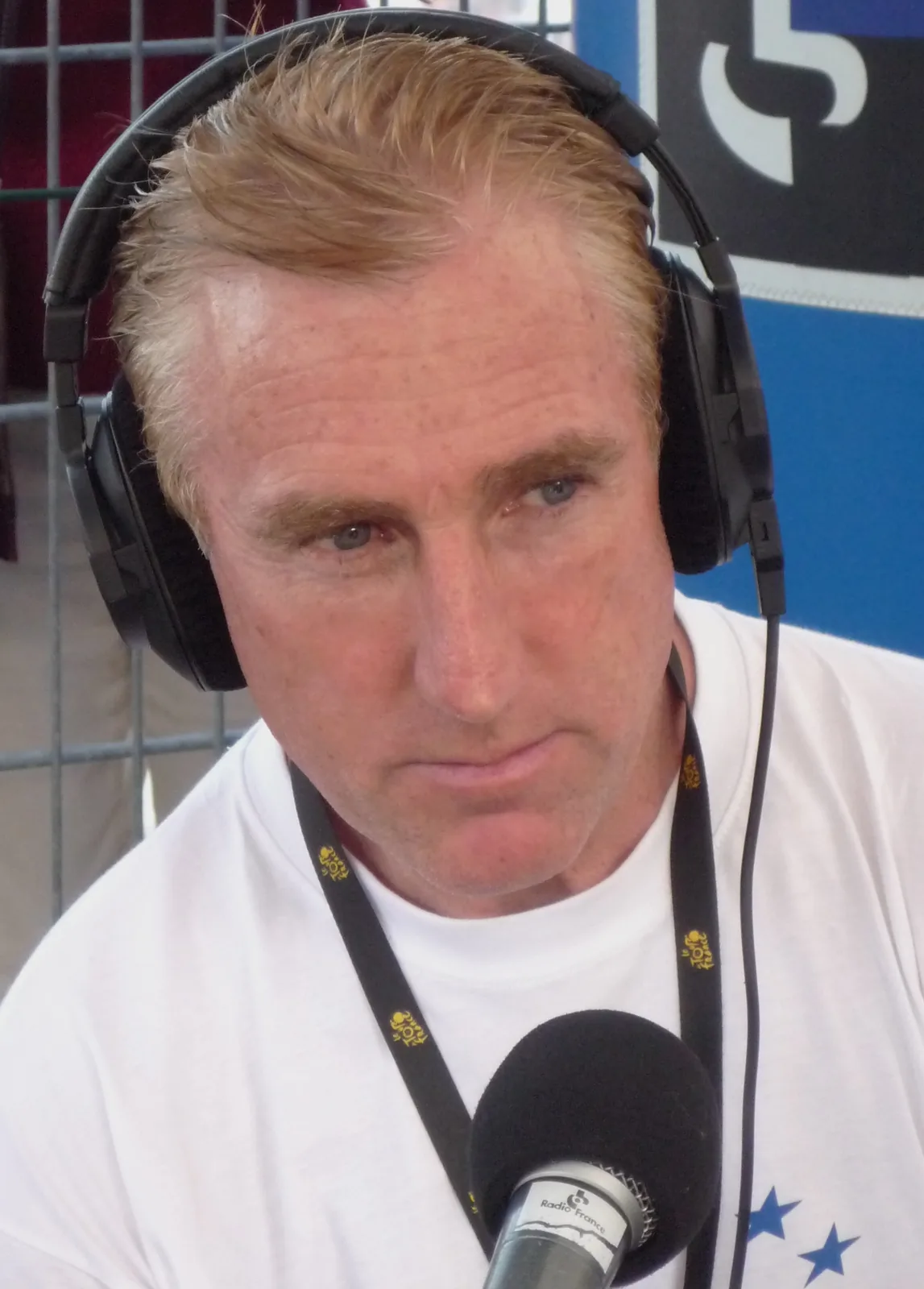
Sean Kelly’s second career was a rider-development business with his name on the door. From 2006 to 2017 he fronted Ireland’s first UCI Continental team, run from an academy house in Merchtem, Flanders, and in 2015 he added a clothing range. The lesson for a board is the division of labour: his name opened doors; a manager ran the house.
I raced on the same small island, and I was Irish junior road champion in 1983. That is not a credential. I never shared a team car with Kelly. Where the public record is thin, I say so.
What did the athlete build after the racing stopped, and what does it teach someone running an organisation? That is the question on From the peloton to the boardroom.
Who is Sean Kelly, and why does his racing record matter here?
Kelly was one of the great classics riders of the 1980s, and that record is the asset he later lent to a team. Without the palmarès there is no sponsorship story, so it is worth stating precisely.
Cyclingnews, profiling him in 2006, summarised the career: world number one for over four years, a then-record four green jerseys at the Tour de France, the 1988 Tour of Spain, and wins in major classics and national tours. The same piece dates his retirement to 1994.
His own Cyclingnews column on Paris–Roubaix adds the detail. He won the race in 1984 and 1986, and the publisher’s note credits him with seven consecutive Paris–Nice wins and double victories at Milan–San Remo and Liège–Bastogne–Liège.
The roots were a club scene, not a system. The Irish Times, profiling Emerald Cycling Club in 1998, records the 1975 Irish team for the British Milk Race: three McQuaid brothers, managed by their father, in a squad “which also included a certain Sean Kelly”. One of those brothers was Pat McQuaid, whose own route ran from the saddle into the federation; by 1998 he was president of the Federation of Irish Cyclists.
What the column says about learning
The Paris–Roubaix column is worth a CEO’s five minutes because it is about acquiring a skill late. “I had to learn because as an amateur I never rode over the cobbles,” Kelly wrote. His first Paris–Roubaix, in 1979, threw him “in at the deep end”. He won it five years later.
His first rule is blunt: “Number one, you need to become a specialist at riding Paris-Roubaix.” He also says preparation “has to start in November, December of the previous year”. Neither line is about talent. Both are about choosing a specialism and investing before anyone is watching.
The two failed tests
The record includes two positive tests. Sticky Bottle reported in 2015 that Kelly returned an adverse result for a product called Stimul at Paris–Brussels in 1984 and tested positive for codeine at the 1988 Tour of the Basque Country. Speaking on RTÉ Radio 1, he said the codeine came from a cough bottle given to him by a pharmacist in Belgium and was not a performance enhancer.
The Irish Times noted in 1999 that “Those positive tests never diminished Kelly’s popularity or earning power.” That is the commercial fact relevant here. I state the cases once and move on.
What did Kelly actually build after he stopped racing?
Three linked operations: an academy house for young riders in Merchtem, a UCI Continental team based in that house from 2006 to 2017, and a clothing range launched in 2015. None was large. All were real, with riders, sponsors or customers.
For most of the first decade after 1994 he stayed close to the sport without running anything. The 2006 Cyclingnews profile says he had “largely limited his involvement in the sport in the years since his retirement to some TV commentary”, including work with Eurosport. The same piece adds that he had been working with young Irish riders for several years and “helped set up a base for them in Belgium”.
Precision matters on ownership. The Sport Ireland release for the 2006 launch says the academy “was opened by Cycling Ireland in Belgium three years ago”, so around 2003. Cyclingnews says the base was relaunched as the Sean Kelly Cycling Academy in 2005. It was a national federation’s programme carrying his name, not a private company he founded alone.
| Year | Racing | Business |
|---|---|---|
| 1975 | Rides the British Milk Race in the Irish team | — |
| 1979 | First Paris–Roubaix, with no amateur experience of cobbles | — |
| 1984 | Wins Paris–Roubaix; positive test for Stimul at Paris–Brussels | — |
| 1986 | Wins Paris–Roubaix again | — |
| 1988 | Wins the Tour of Spain; positive test for codeine at the Tour of the Basque Country | — |
| 1994 | Retires | Moves into TV commentary, including Eurosport |
| c. 2003 | — | Cycling Ireland opens a base for young Irish riders in Belgium |
| 2005 | — | Base relaunched as the Sean Kelly Cycling Academy in Merchtem |
| 2006 | — | Sean Kelly Racing Team launched in Dublin on 23 January |
| 2010 | — | Matt Brammeier leaves for HTC; Sam Bennett signs for 2011 |
| 2015 | — | Sean Kelly clothing range launched with ONDA |
| 2017 | — | An Post ends its sponsorship; the team will not race in 2018 |
How did the Sean Kelly team start in 2006?
It was launched on 23 January 2006 in Dublin as the first UCI-registered Continental-level team to come out of Ireland, with Kelly as team director. It was a joint effort of Kelly, Cycling Ireland and the academy, and it was put together in about four months.
RTÉ reported on launch day that the squad would be based in Belgium, predominantly Irish, with several Belgian riders, and would race professional and amateur events in Europe. The Sport Ireland release named the main sponsor as M Donnelly & Co Ltd, alongside the Belgian company ACLVB Liberale Vakbond, and listed equipment partners from Merlin bikes to Mavic wheels.
Kelly gave the purpose in one line: “If Irish cyclists are to compete and succeed on the world class stage then they need to be racing at a high standard week in week out.” That is a market-access argument. Irish riders were not short of talent; they were short of a calendar.
The release is also candid about cost: “The running of any continental team requires vast amounts of funding.” I could not find a published budget for any season of the team, so I will not guess one.
Why a reluctant founder still said yes
Cyclingnews quoted Kelly at the launch: “To be honest, returning to the sport and running a team was never something I really dreamed about.” He then described a late decision: “we were wondering if we should wait another year, but ultimately I think the best thing was to do it now.”
Former Ireland manager Frank Campbell, who helped chase sponsors, set the expectation just as plainly: “It is a development team, let’s not forget that.” He added that they were “not going to go out and win any huge races”. Few launches are that honest about what success will look like.
Who ran the team day to day, and why does that matter?
Kurt Bogaerts ran it; Kelly lent the name and attended some races. Both men said so publicly, and the arrangement lasted twelve seasons.
At the launch, Bogaerts was described as general manager and, in the first year, a rider as well. He was explicit about what Kelly contributed: “It definitely makes the job easier, the most important thing is his name.” Cycling Ireland’s chief executive, Tamara O’Driscoll, said the same in Cyclingnews: “If you have Sean’s name, that carries a lot of weight.”
Four years later, Kelly described the split himself. He did some early-season races, “but not as many as I’d like because of the clashes with my Eurosport work”. Of Bogaerts he said: “he’s the man that’s running it on a day-to-day basis.”
The board-level reading
This is the part I would put in front of a chair or a founder. Kelly did not pretend to be the operator. He was the reputation, the sponsor conversation and the occasional presence in the team car. Bogaerts was the calendar, the riders and the house.
Many former athletes, and many founders, get this wrong in one of two directions. Some lend a name and vanish, leaving a licence rather than a business. Others insist on running everything and become the bottleneck. Kelly’s arrangement sat between those, and it held.
It is also what I mean by getting good people around you: naming the person who does the daily work, and saying so in public.
Did the team produce riders, and what did that cost it?
Yes. It moved riders up to the top level, and each success removed a rider the team had paid to develop. Kelly said both things out loud.
In 2010, Irish champion Matt Brammeier signed for HTC after two seasons with the team. In November that year Kelly told Cyclingnews that “in one way it was our goal but in another way it’s a disappointment”, and called on the UCI to introduce transfer fees to compensate smaller squads. He also listed earlier departures to Topsport-Vlaanderen and Cervélo.
That is a familiar problem in any organisation that develops people. If you are good at it, larger competitors recruit your best. The team’s answer was to keep signing young riders. For 2011 those included a 20-year-old from Kelly’s own town.
Sam Bennett’s entry
Cyclingnews reported in February 2011 that Sam Bennett, from Carrick-on-Suir, had signed with An Post-Sean Kelly at the end of a difficult 2010 and made his professional debut at the Tour of Qatar. His account of the signing is the best description of the team’s culture I found: “Then Sean Kelly and Kurt Bogaerts really took me under their wing and looked after me.”
Bennett also handled the comparison sensibly: “every new rider in Ireland is the new Kelly.” In the same interview he described watching Tom Boonen, the Belgian star he had spent years watching on television, now racing alongside him in Qatar and Oman. That gap between watching and racing is exactly what a Continental team exists to close.
Why did the team stop after 2017?
It ran out of a title sponsor. An Post confirmed in 2017 that it would end its long-time sponsorship, no replacement was found, and the founders confirmed the team would not race in 2018.
Cyclingnews reported on 30 October 2017 that Kelly and Bogaerts blamed external conditions for the failed search: “the implications of Brexit and the political scenario in Catalunya impacted the decisions of interested parties”. They said they hoped to return in 2019. I found no evidence in my sources that it did.
Their closing statement listed what the team had done. “We created an environment which nurtured honest hard work combined with determination,” they wrote, naming Sam Bennett, Ryan Mullen, Conor Dunne and Matt Brammeier among the Irish riders who reached the top levels. Cyclingnews noted that Bennett had won 10 races in 2017 for Bora-Hansgrohe.
Twelve seasons is a long run for a development squad funded by sponsors. The ending was a funding decision, not a scandal. For a board, the point is concentration risk: one title sponsor carried the business, and when it left, the business stopped.
Where does the clothing range fit?
It is the smallest of the three and the most conventional: branded kit made by a specialist partner. It was launched in January 2015 with ONDA, the company that also produced the team’s clothing.
Sticky Bottle reported that the range carried his autograph and the titles of races he had won, and that the partnership would also produce custom kit to order, aimed first at the UK and Irish market. Kelly framed the product around weather: “I wanted a really high quality bikewear solution for the changeable conditions of Irish winters.”
I like that sentence because it is a product brief, not a memoir. It names a customer, a climate and a problem. The same piece describes him as “better known these days as a commentator on Eurosport”, which is honest about where the name was earning its keep in 2015.
I could not find reliable revenue, volume or staffing figures for the clothing business. The comparison with Eddy Merckx, who built a frame factory under his own name, is instructive: Merckx went into manufacturing; Kelly partnered with a specialist maker and kept his attention on riders.
What transfers from Kelly’s racing to running an organisation, and what does not?
Patience, specialism and the habit of preparing months ahead transfer well. The idea that a great name can run the operation does not; Kelly himself never claimed it could.
What transfers. Kelly’s Paris–Roubaix column is a lesson in deliberate specialism: learn the terrain you were not raised on, prepare from November, save your effort for the final. Those are sound operating habits. So is his launch-day realism about a late start: decide, then build.
What transfers, with care. A reputation can raise capital. Bogaerts and O’Driscoll both said Kelly’s name made sponsorship easier. That is real value. It is also finite, and it depends on the person behind it staying visibly involved.
What does not transfer. Winning races is a solo or small-team act with a clear finish line. Running a development team is a long season of payroll, recruitment and losing your best people to richer rivals. Kelly’s answer was to hand the operation to someone who loved doing it every day.
What I would ask a client in Kelly’s position. Who runs this in the working week? What happens if your largest funder leaves? Which of your best people will a competitor take next year, and are you content with that? Those questions sit at the heart of the work I do on moving from elite sport into the boardroom.
Kelly did not build a large company. He built something that gave young Irish riders a calendar, kept a famous name honest by attaching it to real work, and ended for an ordinary commercial reason. That is a more useful model for most former athletes, and most founders, than a museum.
Questions I am asked
What did Sean Kelly build after he stopped racing?
An academy house for young riders in Merchtem, Flanders, a UCI Continental team based there from 2006 to 2017, and a branded clothing range launched with ONDA in 2015. He also worked as a TV commentator, including for Eurosport.
Did Kelly run the team himself?
No, not day to day. In 2010 he told Cyclingnews that Kurt Bogaerts was “the man that’s running it on a day-to-day basis”, while Kelly attended some races around his Eurosport work.
Which riders came through the team?
Sam Bennett is the best known. He signed at the end of 2010, and when the team closed in 2017 its founders also named Ryan Mullen, Conor Dunne and Matt Brammeier among the Irish riders who reached the top level.
Why did the team stop?
It could not find a title sponsor. An Post ended its sponsorship in 2017, and the founders said Brexit and the political situation in Catalonia had affected the decisions of interested sponsors.
Did Sean Kelly ever fail a doping test?
Yes, twice. Stickybottle reported a positive for Stimul at Paris–Brussels in 1984 and for codeine at the 1988 Tour of the Basque Country; Kelly later said the codeine came from a cough bottle.
What should a CEO take from Kelly’s second career?
Be clear about what you bring and what someone else must run. Kelly’s name raised the sponsorship; a full-time manager ran the riders, the calendar and the house.
Sources
- My Club: Emerald Cycling Club — The Irish Times, 22 June 1998
- Wheels of intrigue turn at a fast rate — The Irish Times, 22 May 1999
- First Irish pro cycling team launched today — RTÉ Sport, 23 January 2006
- CYCLING Sean Kelly Professional Team — Sport Ireland, 25 January 2006
- Sean Kelly Racing Team: Irish legend backs new continental team — Cyclingnews, 10 February 2006
- Kelly calls for UCI to introduce transfer fees in cycling — Cyclingnews, 14 November 2010
- Bennett enjoying professional debut — Cyclingnews, 17 February 2011
- Sean Kelly launches new clothing range; new website features trophy room tour — Sticky Bottle, 15 January 2015
- Cyclist Sean Kelly comments on his doping positives — Sticky Bottle, 3 August 2015
- Sean Kelly: How to win Paris-Roubaix — Cyclingnews, 8 April 2016
- Time runs out to save An Post-Chain Reaction — Cyclingnews, 30 October 2017
Elite executive coach
Book a 30-minute strategy call
Other riders: Eddy Merckx; Greg LeMond; Chris Boardman; Sir Chris Hoy; Alberto Contador; Fabian Cancellara; Tom Boonen; Jonathan Vaughters; Pat McQuaid.