Pat McQuaid: Irish champion, race organiser, then the UCI
Ireland · Race organisation (Tour of Ireland, Tour de Langkawi); Federation of Irish Cyclists; UCI president 2005–2013; cycle tourism · Sport governance and events
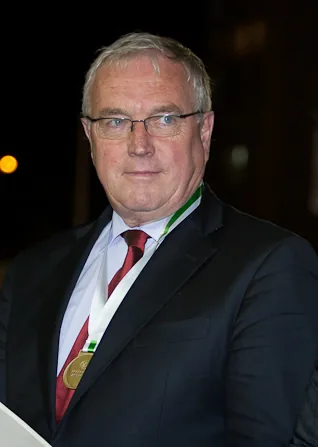

Achievements
Pat McQuaid is the Irish road champion who spent his second career running cycling rather than racing it. He won the national title in 1974 and the Tour of Ireland twice, then organised races, led the Irish federation, and was president of the UCI, the sport’s world governing body, from 2005 until he lost the 2013 election.
He led institutions rather than founding a company. His presidency overlapped the worst doping scandal in the sport’s history.
A testimonial from Pat McQuaid appears on this site. I do not lean on his words about me.
What did Pat McQuaid win as a rider?
He was Irish road race champion in 1974 and won the Tour of Ireland in 1975 and 1976. That is a national champion’s record, not a Tour winner’s, and it is enough to know the peloton from the inside.
The Irish Times, in June 1998, recorded both results and noted that he raced in the colours of Emerald Cycling Club, which his father and uncle had founded in Dublin in 1949. The piece says the club had “geared itself towards producing top cyclists that can compete at the highest level”.
The same article describes a cycling family. His father was selected for the 1948 London Olympics and managed the Irish team in Mexico in 1968. Two brothers rode the Munich and Montreal Games. In 1975 three club members, McQuaid and two of his brothers, rode for Ireland in Britain’s Milk Race, managed by their father, in a team “which also included a certain Sean Kelly”.
The Guardian, in October 2012, added wins in the Tours of the Cotswolds and the Pennines in the 1970s. It also reported that he narrowly missed selection for the 1972 Munich Olympics.
It recorded one episode that cost him. In 1975, when sporting contacts with South Africa were banned, he tried to race there under an assumed name, with Sean Kelly. He was unmasked and lost the chance of a place at the next Olympics. That is part of the Irish story told in Sean Kelly’s profile, which starts in the same club generation.
Did he race as a professional?
The sources disagree. The UCI’s history of its presidents calls him the only UCI president “to have had a career as a professional cyclist”. A VeloNews election briefing in 2013 says he “rode as a professional in the late 1970s”.
But The Guardian quoted McQuaid himself in 2012: “I was a good amateur myself in my day and I took a decision not to go professional. I went to college instead.” The paper said he retired from competition in 1981. Both accounts are in print. The national title and the two Tours of Ireland are not in dispute.
How did he move from racing into running races?
Through team management, rider management and race promotion. By the late 1990s he led the national federation and had brought the Tour de France start to Ireland.
The Guardian traces the steps: after retiring in 1981 he managed Ireland’s junior team, a squad that included the future professional Paul Kimmage, then moved into rider management and race promotion. The Irish Times adds that he managed the Irish team at the 1984 Los Angeles Olympics.
By June 1998 the Irish Times described him as president of the Federation of Irish Cyclists and “the man most responsible for bringing the 1998 Tour de France start to Ireland”. The Guardian notes that the same Grand Départ was overshadowed when French police found a Festina team van containing doping equipment.
The UCI records that he organised the Tour of Ireland and the Tour de Langkawi. Organising a stage race is already a business: sponsors, police, hotels, broadcasters and a route that has to work on the day. It is the part of a sporting career that people outside the sport tend to underrate.
How did he reach the UCI presidency?
He went up through the UCI’s own structure, with the backing of the outgoing president. He was elected in September 2005.
According to The Guardian, he was elected to the UCI in 1998 and appointed president of its road commission by Hein Verbruggen, who led the governing body from 1991 to 2005.
The UCI says he was “elected comfortably” in September 2005 with Verbruggen’s backing, after Verbruggen withdrew to concentrate on work for the International Olympic Committee. It describes him as initially “the man of continuity”.
That succession matters for what follows. A chair who arrives as the predecessor’s choice inherits the predecessor’s relationships and disputes, as well as the office.
What did the UCI change under his presidency?
According to the UCI, it expanded the sport globally and introduced several anti-doping measures. Contemporary coverage credited the biological passport in particular.
The UCI’s own history lists new major races in Australia, China, Africa and Canada. It says that from 2007 he imposed an anti-doping charter on riders, created the Cycling Anti-Doping Foundation, made peace with Tour organiser ASO in 2008, and introduced the biological passport.
His 2013 manifesto, summarised by VeloNews, pointed to the same record, plus a “no-needle” policy, equal prize money for men and women at the UCI world championships, and continental tours in Europe, Africa and elsewhere.
VeloNews judged his globalisation record “arguably among his strongest”, noting his claim of “enormous growth” in races and professional teams and the “emergence of African, Asian and American cycling as new forces”. His plan was more of the same, including expanding the UCI World Cycling Centre as a “University of Cycling” to train more athletes, coaches and mechanics from around the world.
For the next term, he promised to move the anti-doping foundation off UCI premises and commission an independent audit of the UCI’s actions during the Armstrong years.
Independent assessments gave some of this credit. The 2015 commission report, as summarised by the BBC, acknowledged “huge improvements” in anti-doping after 2006 and the early adoption of the biological passport. Even VeloNews, in a briefing that was critical of him overall, said world cycling was “in better shape” than when he took over.
How did the Armstrong era affect his presidency?
It became the central issue of his presidency. Critics focused on how the UCI handled Lance Armstrong, and a 2015 independent report criticised both him and his predecessor while clearing them of corruption.
In August 2012 the United States Anti-Doping Agency banned Armstrong for life and stripped his seven Tour titles, as the BBC later summarised. In October that year McQuaid told The Guardian: “My personal objective is to work on today and tomorrow, the here and now, rather than the past.”
That interview came days before the UCI’s leaders met to discuss a possible truth and reconciliation process for doping. McQuaid was sceptical. “If they come forward – and that’s a big ‘if’ – will it help much in the future?” he asked. He added: “We do face the past. I’ve faced the past on several occasions since I was elected.”
The same Guardian piece reported that McQuaid and Verbruggen had begun a libel action against Paul Kimmage, who had questioned the UCI’s acceptance of donations from Armstrong. McQuaid’s response, quoted there, was: “All I’ve done, all my life, is work for the benefit of this sport. I will not accept to be called corrupt.”
Pressure also came from the teams. Cyclingnews reported that in 2012 the professional teams’ association unanimously agreed it had no confidence in the UCI’s leadership. That association was chaired by Jonathan Vaughters, a former rider who was running his own team and the teams’ collective voice at the same time.
In March 2015 the Cycling Independent Reform Commission published its report. The BBC summarised it as clearing the UCI’s former leaders “of outright corruption” while censuring them “for a litany of failings”. The report accused Verbruggen and McQuaid of failing to follow the UCI’s own anti-doping rules and of preferential treatment of Armstrong.
Specific findings, as the BBC reported them, included McQuaid’s decision to let Armstrong ride the 2009 Tour Down Under before the required six months of testing availability, and the UCI asking for and accepting two large donations from Armstrong. The report also criticised electoral practices in 2005 and 2013. Both McQuaid and Verbruggen welcomed its central finding that there was no evidence of corruption or direct collusion.
That is what the report and its coverage say.
What happened in the 2013 election?
He lost. Brian Cookson, president of British Cycling, beat him by 24 votes to 18 in Florence on 27 September 2013, after a dispute over whether McQuaid could stand at all.
The BBC reported that Cycling Ireland first nominated him and then reconsidered at an extraordinary general meeting. Switzerland, where he lived, also withdrew support. He stood with nominations from Thailand and Morocco, and the congress debated his eligibility at length before Cookson urged the 42 delegates to vote.
The VeloNews briefing three weeks earlier had set out the competing cases. Cookson pledged an independent anti-doping unit and an independent investigation of alleged UCI cover-ups in the Armstrong era. McQuaid ran on his record and a manifesto titled “A Bright Future for a Changed Sport”. The briefing also listed his critics’ complaints, including his handling of the Armstrong affair and the 2009 Tour Down Under decision.
McQuaid’s response to the result, as the BBC reported it, was brief: “That’s life, that’s the way it goes. Congress has decided.” On allowing the vote to go ahead, he said: “We gave an election and we got a result.”
Not everyone was as measured. The BBC also quoted a statement from the United States Anti-Doping Agency, which said the outcome “sends a powerful message that sport leaders who fail to fully protect the rights of clean athletes and the integrity of their sport will be held accountable”. That is USADA’s view, reported as such.
VeloNews had made a sharper point before the vote: that public opinion of the two candidates was “dictated by existing reputations, rather than promises of what they’ll achieve in the future”. Manifestos rarely win an election against an eight-year record, whichever way that record cuts.
After he left office, the UCI records, he moved to the south of France and organised cycle-touring trips for amateur cyclists, before returning to Ireland. I could not find reliable figures for the size of that business, so I give none.
| Year | Racing | Business |
|---|---|---|
| 1974 | Irish road race champion | — |
| 1975 | Wins the Tour of Ireland; rides the Milk Race for Ireland | — |
| 1976 | Wins the Tour of Ireland again | — |
| 1981 | Retires from competition | Moves into team management, then rider management and race promotion |
| 1984 | — | Manages the Irish team at the Los Angeles Olympics |
| 1998 | — | President of the Federation of Irish Cyclists; Tour de France starts in Ireland; elected to the UCI |
| 2005 | — | Elected UCI president |
| 2008 | — | Settlement with Tour organiser ASO |
| 2013 | — | Loses the UCI election to Brian Cookson, 24 votes to 18 |
| After 2013 | — | Organises cycle-touring trips in the south of France |
What transfers from racing to running an organisation, and what does not?
Knowledge of the sport and the craft of organising transfer. Independence, distance from the people you regulate and a mandate of your own do not come with a racing licence. They have to be designed.
I came through the same Irish road scene a few years later, as a junior. What it teaches is real: how a race is actually run, what riders will and will not tolerate, how small the world is. McQuaid took that knowledge from club racing into race promotion, the national federation and the UCI. Few governing-body presidents have known their sport that closely.
What transfers. Organising a race is a business apprenticeship. Sponsors, routes and the people who keep a race safe on the day teach you to deliver to a fixed date. The UCI’s history credits the know-how from his federation and race-organising years with enabling him “to defuse many crises”.
What transfers. Composure in defeat. “Congress has decided” is a short sentence. Many chief executives who lose a board vote take longer to say less.
What does not. Closeness. Knowing everyone in a small sport is an asset for a race director and a risk for a regulator. The criticisms reported in 2015 were largely about process: not following the UCI’s own rules, and what Cookson, quoted by the BBC on the report, called “individuals taking crucial decisions alone” and “an extraordinary position of proximity to certain riders”. A board chair should read that as a warning for any organisation that regulates people it knows well.
What does not. Inherited legitimacy. He arrived as his predecessor’s choice and, in 2013, lost the nomination of his own national federation before the vote. When the people who put you forward start to hesitate, that is information. Treating opposition as information rather than an obstacle is the subject of handling resistance.
For a former athlete now chairing a federation, a family firm or an industry body they once competed in, this is the case to study. It is about institutions, not sainthood. It is the conversation I have in From elite sport to the boardroom: the identity you bring from sport, and the structures you need so that it does not do all the governing. The other riders in From the peloton to the boardroom show the same test from different angles.
Questions I am asked
What did Pat McQuaid win as a rider?
He was Irish road race champion in 1974 and won the Tour of Ireland in 1975 and 1976, racing for Dublin's Emerald Cycling Club. The Guardian adds wins in the Tours of the Cotswolds and the Pennines in the 1970s.
Did McQuaid race as a professional?
The sources disagree. The UCI and VeloNews describe a professional career in the late 1970s, while The Guardian quoted McQuaid in 2012 saying he had decided not to turn professional and went to college instead.
When was McQuaid president of the UCI?
From September 2005 to September 2013. He was elected with Hein Verbruggen's backing and lost a third-term vote to Brian Cookson by 24 votes to 18 in Florence on 27 September 2013.
What did the 2015 independent report say about McQuaid?
The Cycling Independent Reform Commission cleared the UCI's former leaders of outright corruption but criticised Verbruggen and McQuaid for failing to follow the UCI's own anti-doping rules and for preferential treatment of Lance Armstrong. Both men welcomed the finding that there was no evidence of corruption.
What did the UCI introduce during his presidency?
The UCI credits him with the biological passport, an anti-doping charter for riders from 2007, the Cycling Anti-Doping Foundation, a settlement with Tour organiser ASO in 2008, and new races in Australia, China, Africa and Canada.
What did McQuaid do after the UCI?
According to the UCI, he moved to the south of France and organised cycle-touring trips for amateur riders, before returning to Ireland.
Sources
- My Club: Emerald Cycling Club — The Irish Times, 22 June 1998
- Vaughters will not seek AIGCP re-election — Cyclingnews, 4 October 2012
- Pat McQuaid focuses on the future, but UCI can't escape cycling's past — The Guardian, 23 October 2012
- What you need to know about the UCI election (part two) — VeloNews, 3 September 2013
- Brian Cookson elected as UCI president, defeating Pat McQuaid — BBC Sport, 27 September 2013
- Doping culture in cycling 'still exists' according to Circ report — BBC Sport, 8 March 2015
- The Presidents of the Union Cycliste Internationale — Union Cycliste Internationale (UCI), 9 April 2025
Elite executive coach
Book a 30-minute strategy call
Other riders: Eddy Merckx; Greg LeMond; Sean Kelly; Chris Boardman; Sir Chris Hoy; Alberto Contador; Fabian Cancellara; Tom Boonen; Jonathan Vaughters.