Tom Boonen: from the cobbles to a supercar dealership
Belgium · Iconiccars (Iconic Cars); Donkervoort dealership for Belgium · Automotive retail
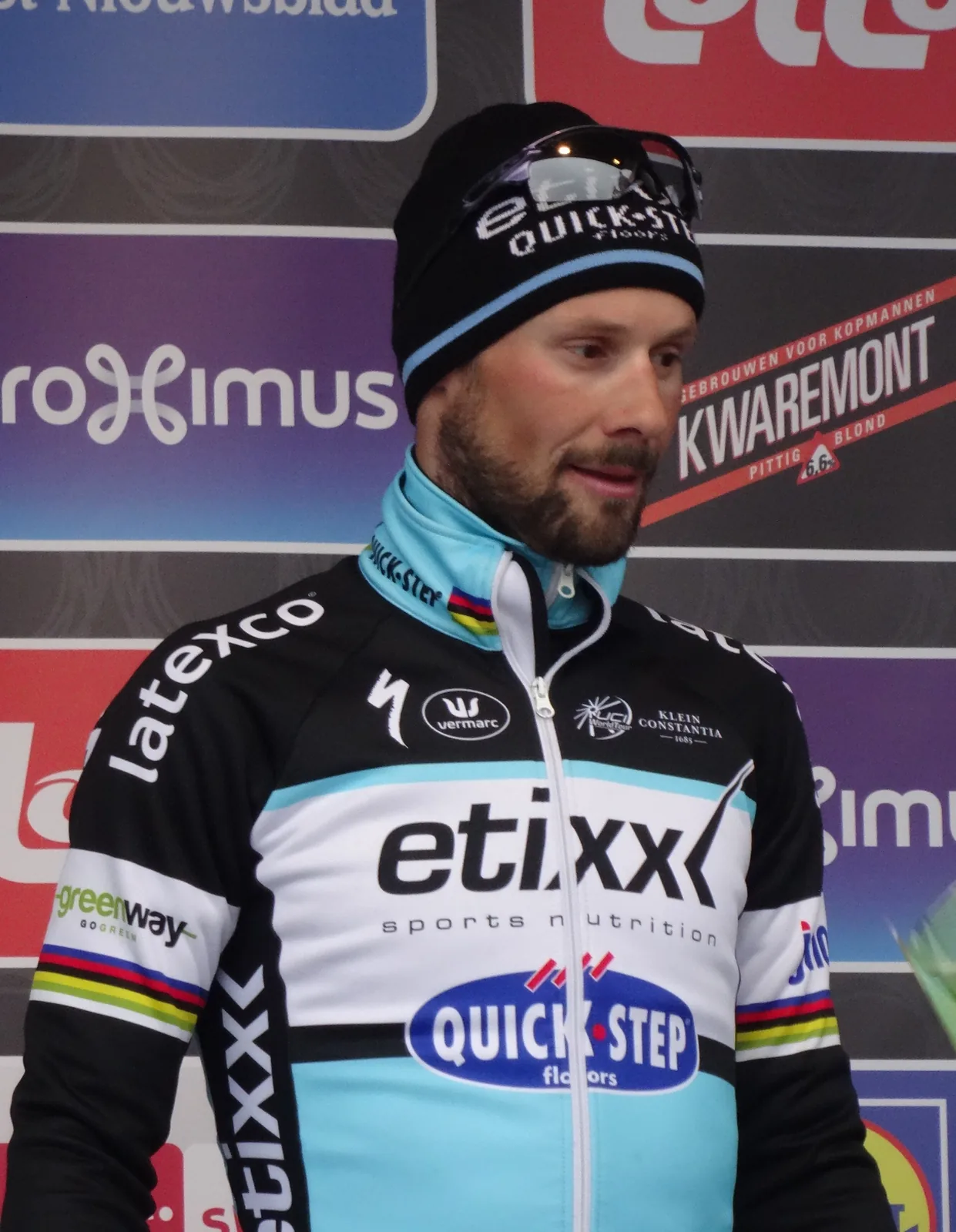

Achievements
Tom Boonen’s second career is a car business, not a bike brand. The 2005 world champion co-owns Iconiccars, a Belgian dealer in rare sports cars that Donkervoort made its official dealer for Belgium in 2021. He chose partners who already knew the trade, then rebuilt the company when its first version stopped feeling like his.
It is not a farewell project. It is a man moving into the trade he had studied as a hobby for most of his life, and learning that fame and passion are not a business model on their own.
What did Tom Boonen win on the bike?
Boonen was a cobbled classics specialist: world road champion in 2005, four times winner of Paris–Roubaix and three times winner of the Tour of Flanders. Bicycling’s retirement report puts his career total at more than 100 wins, including the Tour de France green jersey in 2007.
Cyclist’s long interview with him fills in the shape. He turned professional with US Postal in 2002, then raced for QuickStep from 2003 to 2017. He won Roubaix in 2005, 2008, 2009 and 2012. In 2005 he took the Flanders–Roubaix double and the world title in the same season, and in 2012 he won both cobbled monuments again, which equalled the record for wins at each race.
His great rival on those roads was Fabian Cancellara. Cancellara later told Cyclist that “when I rode there was me and Tom Boonen.” The two men left racing in different directions: Cancellara went into team ownership, Boonen went into cars. Same races, same era, two quite different answers to what comes next.
In May 2008 Boonen tested positive for cocaine in an out-of-competition control run by the Flemish government. Cycling Weekly reported that cocaine was not a banned substance out of competition and that he faced no sporting sanction, but the Tour de France organiser excluded him from the 2008 race. Cyclist counts three failed tests for cocaine between 2007 and 2009. The same piece reports that Belgian authorities accused him of tax evasion over his years living in Monaco and fined him €2 million.
What does a classics champion learn that a CEO can use?
Three things: how to win with a team, how to manage fame, and how to read a long race. Boonen speaks well on all three, and his own words are more useful than my summary.
On the team, he told Cyclist: “I helped make the team and they helped make me. Guys with us rode 10% better than they used to because of the team ethic.” That is a description of culture as a performance multiplier, from someone who spent 15 of his 16 professional seasons at what Cyclist calls arguably the strongest classics team in history. Any chief executive who thinks culture is a poster should read it twice.
On fame, he was honest about the year he became world champion: “I was 24 or 25 and neither me nor the team handled it too well. We took on too much.” I hear the same sentence from founders after a large funding round and from executives after a public promotion. Success adds requests faster than it adds capacity. The series part on the temptations of successful leaders is about exactly this moment.
On race craft, he described the 2012 Tour of Flanders, where he was in a lead group with Filippo Pozzato and Alessandro Ballan: “I pretended I was dead.” He let them think he was beaten and never let them go. “Cycling’s such a mental game,” he said. “You have to create the right circumstances for you.” In a negotiation or a board debate, timing matters more than strength.
How did his racing career end, and what came next?
He rode his last race at Paris–Roubaix on 9 April 2017, finished 13th, and turned to motor racing the same year. Cyclingnews reported that he had no regrets: “It was time. I’m happy it’s finally this day.”
Asked what he would do next, he answered: “Now? I’m going to look for my car.” It was a joke at the team bus, and also the plan. Classic Driver reported that he obtained his motor racing licence and competed in the 25-hour VW Fun Cup at Spa-Francorchamps less than a month after retiring. (The same article misdates his retirement to 2015; the race reports put it in April 2017.)
Donkervoort also dates his move into racing cars to 2017. Autofans notes that he contested the Belcar series with Sam Dejonghe. When Cyclist visited, he showed a trophy from a 24-hour race in Dubai, the first win for his Belgian team, AC Motorsport.
That speed of transition matters. Most retiring athletes take a year or two to work out what they want. Boonen did not need to, because the second interest had been running alongside the first for decades. He told Classic Driver: “Cars and motorsport have always been two of my main interests in life.” He added that he did a school project on the Bugatti EB110 when he was 11, and always took car magazines to races.
What is Iconiccars, and who runs it?
Iconiccars is a dealer in rare sports cars and supercars, founded with established car traders rather than by Boonen alone. Classic Driver described it in 2019 as the supercar dealership he founded in Tienen with Joeri Vanhumbeek, CEO of the Carconnex network.
That 2019 article is marked as sponsored, and its production was supported by Iconiccars, so I treat its description of the business as the company’s own account. The quotations are still his. In it, he described the stock as ultra-rare supercars and hypercars, and the pitch as service: “There will always be a market for the rarest and most special cars.”
During Classic Driver’s visit the floor held a yellow Ferrari Sergio, one of six built, an Italdesign ZeroUno, one of five, and a Donkervoort D8 GTO-RS. That last car is a clue to where the business would go next.
The scale of the stock is not trivial. Boonen told Cyclist that the showroom had sold two McLaren P1s, an Aston Martin One-77 and a Bugatti Veyron. He also said it did not take up much of his time, and that it helped him replace the structure and competition he missed after racing.
That last point deserves attention. “For 20 years, everything’s clear,” he said. “You have your goals.” Retirement removes the calendar, and a business brings one back. I see the same pull in executives who leave a large role: the next project is partly about the work and partly about getting their structure back. Both are legitimate. It helps to know which one you are buying.
Why did he rebuild the business?
Because the first version was about cars as investments, and his interest was in cars as machines to drive. In February 2021 he told Made in Kempen that his story at Iconiccars had begun a little under four years earlier, when it was part of the car trader Carconnex in Tienen.
He described that first phase plainly. It was mostly about supercars such as McLarens and Ferraris, at a time when many buyers saw them as investments. Iconiccars sold new and used cars from stock. But, in my translation of his Dutch, he said he could not put his heart into it, because the project was too much about investment and not enough about passion.
So the business moved. Iconiccars relocated with the Leuven entrepreneur Steven Lismont to Zandhoven, near Antwerp, and the two set out to give it a new identity. Boonen said they wanted honest, transparent car trading aimed at enthusiasts. He objected to sports cars disappearing into collections and never covering more than 3,000 kilometres: they were built to be enjoyed.
This is the part of the file I would put in front of a board. Boonen did not walk away from a business that was not right. He kept the asset and the network, changed the partner structure, and moved the customer from the investor to the enthusiast. That is a strategy reset, done by a founder who was honest with himself about why the first version felt wrong.
What does the Donkervoort dealership add?
It is a manufacturer’s endorsement, which a famous name cannot give itself. On 18 February 2021 Donkervoort announced that Iconic Cars in Zandhoven had become its dealer for Belgium, its sixth dealership in Europe.
The Dutch manufacturer said the dealership was developed by “experienced dealer Steve Lismont” and Boonen, and would sell new and pre-loved Donkervoorts and send cars to the Lelystad headquarters for servicing. Managing director Denis Donkervoort was specific about Boonen’s role: “Tom has owned a Donkervoort for five years and believes in our product so much that he’s invested his own time and money to become a part of our future as well.”
That sentence separates an owner from an ambassador. Boonen was a customer first, then an investor and operator. His own line in the release was: “To be granted the dealership rights in Belgium is a huge honour.” Rights are granted, and they can be withdrawn. A manufacturer chooses its dealers on how they sell and look after customers, not on Roubaix cobbles.
The release also showed how the dealer planned to sell: by turning up where owners drive. Iconic Cars intended to attend most of Donkervoort’s premium track days that year, starting at Spa-Francorchamps on 27 March. For a former racer selling driver’s cars, the circuit is the showroom. It is also a sales channel his fame helps with, and one his partner’s trade knowledge has to convert.
Autofans described Boonen as one of the managers of the company alongside Lismont, and noted that Iconic Cars remained an independent distributor. In the racing world he had always been the protected leader. Here he was a partner in a small independent dealer.
Is the business making money?
The one verifiable figure is a profit of just over a quarter of a million euros in the financial year to the end of August 2021. P-Magazine reported it from the company’s published accounts and said it reduced a loss carried forward.
The same report says Boonen holds his stake through his own company, and that the parent companies, Germanus and TB Solutions, had declared they would continue to support the company financially. I could not find a reliable revenue figure, a headcount, or audited results for later years. I will not guess at them.
What the numbers do show is a business that had a loss on its books, then a profitable year after the reset and the Donkervoort appointment. One good year is not a trend. But it is a real profit and loss account, which is more than most champions’ second careers can show.
What transfers from racing to running a company, and what does not?
The second craft transfers; the palmarès does not. Boonen’s long interest in cars gave him taste, a network and credibility with enthusiasts, and his wins opened the door. Neither could sell a car on a wet Wednesday, and he did not pretend otherwise.
Four lessons I would take into a boardroom:
- Keep a second craft alive while you are still in the first. Boonen’s car magazines in the team bus were an apprenticeship. Leaders who only have the current job have nothing to step into when it ends.
- Found with people who already run the trade. Vanhumbeek in Tienen and Lismont in Zandhoven knew the business. Getting good people around you is not a slogan when you are new to an industry. It is the plan.
- Rebuild the version that is not yours. He said plainly that the investment-led first phase did not hold his heart, and the business changed shape. Many founders keep running a model they no longer believe in because it works on paper.
- Put money in. Donkervoort’s line about “his own time and money” is the difference between a face on the stand and an owner.
The comparison with other classics riders is useful. Sean Kelly stayed in the sport, building an academy and a team close to the roads he raced on. Eddy Merckx learned to build frames before he sold them, and found a teacher to do it. Boonen left the sport’s supply chain altogether and went to the trade he had followed since childhood. None of the three routes is the right one. Each was chosen on purpose.
What does not transfer is the protected-leader habit. On a classics team, the leader is delivered to the decisive moment by everyone else. A small dealership has no domestiques. If the business only works when the famous partner is in the showroom, you have built a meet-and-greet, not a company. I work through that gap with athletes and executives on my elite sport to boardroom coaching, and the first question is always the same: what is your second craft, and who already knows how to run it? The other riders in From the peloton to the boardroom show the same test from different angles.
Career-to-business timeline
| Year | Racing | Business |
|---|---|---|
| 2002 | Turns professional with US Postal | — |
| 2005 | Wins Flanders, Paris–Roubaix and the world road title | — |
| 2008 | Second Paris–Roubaix win; excluded from the Tour after a cocaine test | — |
| 2012 | Flanders–Roubaix double for the second time | — |
| 2017 | Last race, Paris–Roubaix, 9 April; turns to motor racing | Around this time, his story at Iconiccars begins, then part of Carconnex in Tienen |
| 2019 | Racing cars | Classic Driver visits the Tienen showroom, founded with Joeri Vanhumbeek |
| 2021 | Racing cars | Iconiccars in Zandhoven with Steven Lismont; Donkervoort dealer for Belgium from 18 February |
| 2021 (financial year to August) | — | Profit of just over €250,000, reported by P-Magazine |
Questions I am asked
What business does Tom Boonen run?
He co-owns Iconiccars, a dealer in rare sports cars and supercars now based in Zandhoven, Belgium. In February 2021 Donkervoort appointed it the official Donkervoort dealer for Belgium.
Who are Boonen's business partners?
Classic Driver reported in 2019 that he founded Iconiccars in Tienen with Joeri Vanhumbeek, CEO of the Carconnex network. The business later moved to Zandhoven with Steven Lismont, an experienced dealer whom Donkervoort names as co-developer of the dealership.
When did Tom Boonen retire from cycling?
He rode his last race at Paris–Roubaix on 9 April 2017 and finished 13th. He turned to motor racing the same year, and his story at Iconiccars began at around the same time.
Is Iconiccars profitable?
P-Magazine reported that the company made a profit of just over a quarter of a million euros in the financial year to the end of August 2021, which reduced a loss carried forward. That is the only financial figure I could verify.
Did Tom Boonen ever fail a drug test?
Yes, for cocaine, in an out-of-competition test in May 2008. It carried no sporting sanction, but the organisers excluded him from that year's Tour de France.
What can a chief executive learn from Boonen's second career?
Pick partners who already run the trade, and be willing to rebuild a business that works on paper but not for you. His fame opened doors; the dealership rights and the accounts had to be earned separately.
Sources
- Boonen calls it a career: 'It was time' — Cyclingnews, 9 April 2017
- Retiring Boonen Enjoys Final Rollercoaster — Bicycling, 10 April 2017
- Boonen excluded from Tour de France by organiser — Cycling Weekly, 11 June 2008
- 'Flanders is hardest to win': Tom Boonen in retirement — Cyclist, 28 March 2021
- From championship cycling to trading supercars with 'Tornado Tom' Boonen — Classic Driver, 24 September 2019
- Tom Boonen: "Passie is de motor van Iconiccars." — Made in Kempen, 28 February 2021
- New dealership in Belgium highlights Donkervoort's expansion strategy — Donkervoort Automobielen, 18 February 2021
- Tom Boonen wordt Donkervoort-dealer — Autofans, 22 February 2021
- Goed jaar voor IconicCars van Tom Boonen en Co — P-Magazine, 6 May 2022
- Fabian Cancellara on life in retirement: 'I'm busier now than when I raced' — Cyclist, 1 November 2019
Elite executive coach
Book a 30-minute strategy call
Other riders: Eddy Merckx; Greg LeMond; Sean Kelly; Chris Boardman; Sir Chris Hoy; Alberto Contador; Fabian Cancellara; Jonathan Vaughters; Pat McQuaid.